
Lifestyle and Home Challenges: Simple Ways to Create a Calmer, Easier Everyday Life
Your home and daily routine have a powerful effect on how life feels. When your surroundings are cluttered, your schedule is constantly reactive, or everyday tasks seem to take more effort than they should, even small responsibilities can become exhausting.
On the other hand, a home that works for the way you actually live and a routine built around realistic priorities can make ordinary days feel noticeably lighter. That is the idea behind lifestyle and home challenges: instead of trying to completely transform your life overnight, you focus on one manageable improvement at a time.
The Lifestyle and Home collection at 2nd Chapter Moments brings together practical challenges designed around exactly this approach, with options for decluttering, home organisation, weekly planning, digital cleanup, wardrobe editing, simple living, and creating more comfortable spaces. The collection currently includes 16 challenges, ranging from three-day refreshes to longer programs designed to build habits gradually.
Why Small Lifestyle Changes Can Make a Big Difference
A lifestyle reset does not have to mean throwing everything away, buying new furniture, following an elaborate morning routine, or spending an entire weekend reorganising your house. In many cases, the most useful changes are surprisingly ordinary.
Clearing the surface where you prepare your coffee, deciding where frequently used items belong, creating a realistic laundry rhythm, removing unnecessary digital notifications, or planning the week before it becomes chaotic can eliminate repeated sources of friction. These improvements matter because they affect things you encounter repeatedly.
A small problem that appears once is rarely significant, but a small frustration that happens every morning, every evening, or every time you need something can gradually become a major drain on attention.
Lifestyle and home challenges turn those recurring frustrations into specific projects with a beginning and an end. Instead of asking yourself to “get your life together,” you can concentrate on one clearly defined outcome and work toward it in manageable steps.
Explore Lifestyle and Home Challenges That Fit Your Current Season
One of the strengths of a challenge-based approach is flexibility. Not every person needs the same type of reset, and not every season of life gives you the same amount of time or energy. Someone who feels overwhelmed by household clutter may benefit from a short decluttering challenge, while someone who has a generally tidy home but struggles with weekly responsibilities may get more value from establishing a predictable home flow.
If your surroundings feel dull rather than chaotic, a small space refresh or cozy-corner project may be enough to create a noticeable change. For people who feel overloaded by possessions, schedules, choices, and commitments, a broader simple-living reset may be more appropriate.
The 2nd Chapter Moments collection includes challenges such as a 7-Day Home Reset Ritual, Wardrobe Confidence Edit, Design Your Weekly Home Flow, 15-Day Simple Living Reset, 7-Day Declutter Dash, Cozy Corner Makeover, and Make Your Home Feel Easier to Live In.
1. Start With a Home Reset That Creates Immediate Momentum

When your home feels out of control, starting everywhere at once is usually the fastest way to become discouraged. A focused home reset gives you a better starting point because it creates a visible result without demanding an enormous commitment. Rather than attempting to deep-clean every room, choose the areas that have the greatest effect on your everyday experience.
This might be the kitchen counter, entryway, bedroom, bathroom, desk, or the place where mail and miscellaneous items tend to accumulate. The 7-Day Home Reset Ritual available in the Lifestyle and Home collection is designed around creating a repeatable reset that brings order, calm, and function back into your space.
The important principle is to make your home easier to maintain, not merely cleaner for one afternoon. Once an area has a clear purpose and frequently used items have obvious homes, maintaining it requires less decision-making.
The result is not perfection; it is a space that supports your daily life rather than constantly asking you to fix it.
2. Try a Seven-Day Decluttering Challenge

Decluttering can feel overwhelming because people often imagine it as a massive project involving cupboards, wardrobes, garages, paperwork, sentimental possessions, and years of accumulated belongings. A better approach is to reduce the scale of the task. Instead of asking how you can declutter your entire home, ask which small zone would feel noticeably better if it were cleared. A drawer, shelf, bedside table, handbag, bathroom cabinet, kitchen cupboard, or digital folder can become a complete project.
The 7-Day Declutter Dash follows this smaller-step philosophy, focusing on clearing manageable clutter zones and building momentum without turning decluttering into an enormous undertaking. This approach also gives you opportunities to learn what kind of clutter repeatedly returns.
If paperwork piles up near the entrance, perhaps you need a better sorting system.
If clothes accumulate on a chair, perhaps your wardrobe arrangement is inconvenient.
If kitchen counters constantly become crowded, perhaps frequently used appliances or ingredients need a different home.
Good decluttering is not simply about removing things; it is about making the environment work better.
3. Make Your Home Easier to Live In
A beautiful home is not necessarily an easy home. A room can look stylish while still creating unnecessary friction every day. Perhaps the item you use most often is stored somewhere inconvenient, the laundry basket is too far from where clothes are removed, your charging cables are scattered across several rooms, or the kitchen tools you rely on are hidden behind things you rarely use. These small design problems can make ordinary tasks feel harder than necessary.
The “Make Your Home Feel Easier to Live In” challenge focuses specifically on reducing these daily frustrations and creating a setup that better supports real life. This is an especially useful mindset because it shifts the goal from creating a picture-perfect home to creating a functional one. Your home should accommodate your routines, habits, energy levels, and priorities.
When you organise according to actual behaviour instead of an idealised version of yourself, maintaining your space becomes more natural.
4. Create a Weekly Home Flow
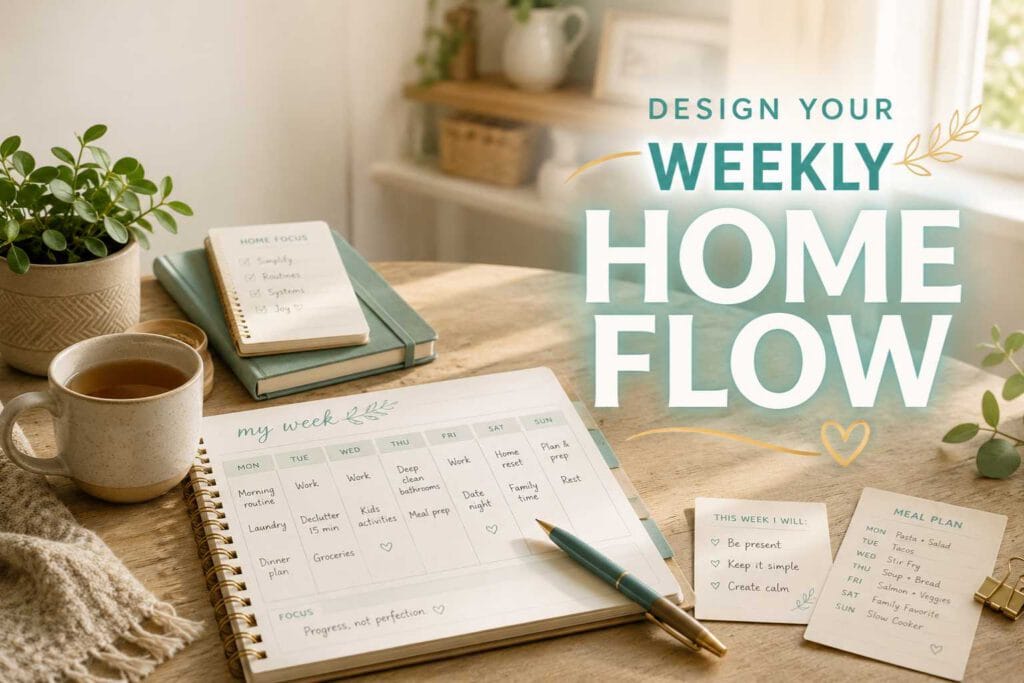
Household tasks become stressful when everything feels urgent at the same time. Laundry needs doing, groceries need buying, meals need planning, surfaces need cleaning, appointments need remembering, and countless small tasks compete for attention. A weekly home flow can reduce that sense of constant reaction by giving recurring responsibilities a predictable place in your week.
The Design Your Weekly Home Flow challenge is built around creating a practical rhythm for home tasks, resets, meals, laundry, and everyday living. The goal is not to create an intimidating timetable where every hour is accounted for. Instead, think in terms of rhythms. Perhaps one day is naturally better for groceries, another for laundry, and another for a more substantial home reset. Some tasks may happen daily, while others only need attention once a week or once a month.
Once recurring responsibilities have a rhythm, you spend less mental energy deciding when to do them.
5. Refresh Your Space Without Redecorating the Entire House

Sometimes a home does not need a renovation; it simply needs a little attention. One small area can change how you experience an entire room. A comfortable chair beside a lamp can become a reading corner. A neglected shelf can become a place for favourite books or photographs. A small table can be cleared and redesigned around something you genuinely enjoy.
The Cozy Corner Makeover challenge encourages this kind of focused transformation by turning one small corner into a comfortable, useful, and inviting space. This is a useful reminder that improving your home does not always require significant spending. Rearranging what you already own, removing visual clutter, improving lighting, adding something meaningful, or simply giving a forgotten space a purpose can produce a surprisingly satisfying result.
The best home improvements are often the ones you notice every day.
6. Simplify Your Lifestyle, Not Just Your Cupboards
Decluttering possessions is only one part of simplifying life. A home can be beautifully organised while the calendar remains overloaded, the phone is filled with unnecessary distractions, and every day is packed with decisions.
The 15-Day Simple Living Reset takes a broader view, focusing on simplifying space, schedules, choices, and daily rhythms so life feels lighter and easier to manage. Simple living does not have to mean adopting a particular aesthetic or eliminating everything enjoyable. It can simply mean becoming more intentional about what deserves your time, attention, money, space, and energy.
You might simplify your morning routine, reduce unnecessary commitments, create a smaller weekly meal rotation, unsubscribe from emails you never read, or establish boundaries around when you respond to messages.
The purpose is to create more room for the things that matter instead of allowing every available space to be filled automatically.
7. Give Your Wardrobe a Confidence Edit

A wardrobe can contain plenty of clothes and still make getting dressed frustrating. The problem is often not a lack of options but a lack of useful options. Clothes that do not fit properly, pieces that no longer reflect your lifestyle, items that require too much maintenance, and impulse purchases that never quite feel right can make an otherwise full wardrobe surprisingly difficult to use.
The Wardrobe Confidence Edit is designed to help make getting dressed easier, more comfortable, and more aligned with who you are now. A useful wardrobe edit begins with the life you currently live rather than the person you imagine you might become someday. Consider what you actually wear, what you repeatedly reach for, what makes you feel comfortable and confident, and what gaps genuinely exist.
This can transform your wardrobe from a storage area into a practical collection of clothing that supports your everyday life.
8. Clean Up Your Digital Home Too

Your physical environment is not the only space that can become cluttered. Phones, computers, email inboxes, photo libraries, downloads folders, cloud storage, and notification feeds can become just as chaotic as a crowded cupboard.
Digital clutter is particularly easy to ignore because it does not occupy physical space, but it can still create friction every time you search for a file, receive an unnecessary notification, scroll through an overloaded photo library, or try to find an important email.
The 10-Day Digital Home Cleanup focuses on making digital spaces calmer, clearer, and easier to use. A digital reset might involve deleting unused apps, organising important files, clearing downloads, unsubscribing from unwanted emails, reviewing notifications, creating sensible folders, or removing duplicate photos. The objective is not to create a complicated digital filing system.
It is to make your technology feel like a useful tool rather than another source of background noise.
9. Plan a Week That Feels Lighter

Planning can sometimes make life feel more complicated, especially when planners become filled with ambitious schedules that are impossible to maintain. Effective weekly planning should do the opposite. It should remove uncertainty and help you identify what actually matters before the week becomes crowded with interruptions.
The Plan a Week That Feels Lighter challenge focuses on fewer loose ends, clearer priorities, and more breathing room. A practical weekly plan can begin with fixed commitments, followed by essential tasks and then optional activities. Leave space between obligations rather than assuming every empty hour needs to be filled.
Consider which household tasks genuinely need to happen this week and which can wait. Decide on a few priorities instead of creating a list so long that simply reading it becomes stressful.
Planning is most useful when it makes your week more realistic, not when it creates another standard you feel pressured to meet.
10. Start Small With a Three-Day Space Refresh
Not every reset needs seven, fifteen, thirty, or ninety days. Sometimes you simply want to change how one area feels right now.
The 3-Day Space Refresh is designed around refreshing one small area so that your home feels lighter, easier, and more pleasant to use. This makes it an appealing starting point for anyone who tends to postpone home projects because they appear too large.
Choose one space that you see or use frequently. Remove obvious clutter, clean the area, return misplaced objects to their proper homes, decide what belongs there, and then make a small improvement that increases comfort or usefulness. Three days is enough time to create momentum without turning the project into an exhausting commitment.
Once you experience the difference one small change can make, you may find yourself naturally looking for the next area that could benefit.
A Simple Lifestyle and Home Challenge Framework

The most effective challenge is the one you can realistically complete. Before choosing one, consider what currently bothers you most. Is it clutter, household maintenance, an uncomfortable workspace, an overloaded schedule, an impractical wardrobe, digital chaos, or simply the feeling that your home does not support the way you live?
Choose the challenge that addresses the actual friction rather than the problem you think you “should” be fixing. Then give yourself permission to work at a sustainable pace. A challenge should create momentum, not another source of guilt.
The Lifestyle and Home collection includes options labelled by duration and difficulty, from easy three-day and five-day challenges through longer daily programs, making it possible to choose a starting point that matches the amount of effort you can realistically give.
The Goal Is a Home That Supports Your Life
The most meaningful lifestyle improvements are rarely about achieving perfection. They are about reducing unnecessary friction and creating environments that make everyday life easier. A tidy drawer matters because it saves time. A sensible wardrobe matters because getting dressed becomes simpler.
A weekly home rhythm matters because recurring chores stop competing for attention. A comfortable corner matters because having a place you genuinely enjoy can change how you use your home. A digital cleanup matters because finding what you need becomes easier. These are small changes individually, but repeated improvements can gradually alter the character of an entire household.
The Lifestyle and Home challenges from 2nd Chapter Moments are built around this practical philosophy: start with something manageable, create a visible or useful improvement, and use that momentum to move into the next small change.

Find Your Next Small Moment
A fresh chapter does not have to begin with a dramatic life overhaul. Sometimes it begins with clearing a surface, organising a drawer, planning the week, making a neglected corner comfortable, removing digital clutter, or deciding that your home should work differently for the person you are today.
The Lifestyle and Home challenge collection provides a range of structured starting points, including the 90-Day Life Upgrade Roadmap for a broader personal reset, the 30-Day Fresh Start Home Calendar for gradual daily home improvements, and shorter challenges for specific spaces, routines, and habits.
Choosing one small project gives you something concrete to act on today rather than an abstract promise to “get organised” someday. And once that first improvement is complete, the next step becomes easier to see. A calmer home and a more manageable lifestyle are not necessarily created through one enormous transformation; they can be built through a series of small, deliberate moments that make ordinary life work better.

Hey, I'm Deb Talbot, Founder of 2nd Chapter Women
As you stand at this pivotal point in your life, remember: you are the author of your next chapter.
Your story is far from over, and in many ways, it is just beginning. The wisdom you’ve gained, the skills you’ve honed, and the passions you’ve cultivated all point to one undeniable truth....you have so much more to offer.
Embrace this time as one of exploration, expansion, and expression. The world is waiting for you to step fully into who you are meant to be in this season of life.
And remember: you are not starting over, you are starting anew, with all the wisdom and strength of your past to guide you.
Subscribe to updates
Stay inspired and on track with your personal & business growth journey.
Let’s grow together!
Benefits for subscribing to updates
Exclusive Opportunities:
Get early access to limited-space events and special promotions
Exclusive Discounts:
Access subscriber-only discounts on business tools, services, and event tickets,
Growth Opportunities:
Helping you develop skills for your specific entrepreneurial journey.
Subscribe
Let's connect!
Enter your details to subscribe for updates!
Name

2nd Chapter Women | Created by: Slight Edge Digital